
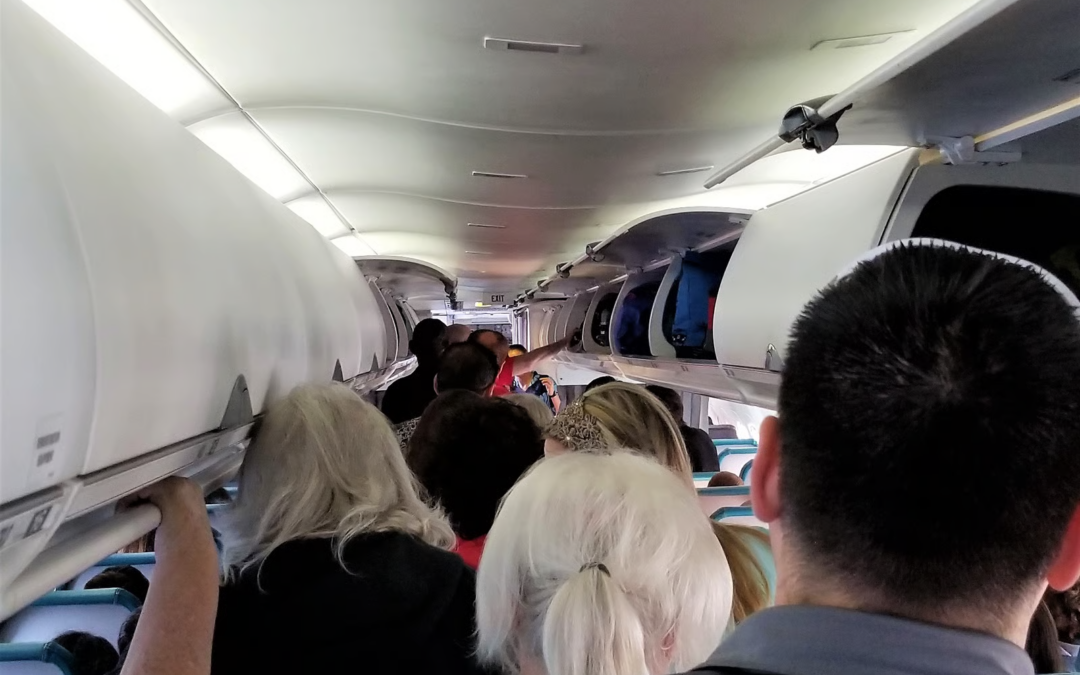
The wheels barely touched the ground. The plane was still rolling. Still fast, still loud, the engines throwing everything into reverse to slow us down.
And somewhere behind me: click.
Somebody’s seatbelt. First one off.
Then another. Then five more. By the time we’re at taxi speed, you can feel the rush and tension building up.
The seatbelt light turns off, and half of the cabin is on its feet, hunched under the overhead bins because the ceiling is too low to stand up straight. Bags in hand. Jackets on. Ready.
Ready for what?
The jet bridge hasn’t even started moving toward us yet. The door is still closed. It’s going to stay closed for another ten minutes.
But there they are: a whole aisle of people, standing, staring at a door that doesn’t care about their rush.
I stayed in my seat. Not because I’m patient (just ask my wife), but because I did the math a long time ago.
That guy in the aisle? The one who shot up the second we landed? He’s going to walk off the plane at the exact same moment as I do.
Same door, same minute. The only difference is he’ll spend his ten minutes with his neck bent and a stranger’s backpack in his ribs, while I’ll spend mine sitting down finishing the movie I was watching.
He didn’t rush to leave. He rushed to wait.
What My Father Taught Me About “Working Too Much”
Watching a cabin full of strangers standing up crooked to go nowhere, I finally understood something my father used to say. It never made sense to me growing up:
“Son, if you work too much, you won’t have time to make money.”
I’d nod like I understood, but I didn’t get it. It sounded backwards. Work too much and you won’t have time to make money? Wait! Isn’t working how you make money?
That’s the deal. That’s the whole arrangement… isn’t it?
It took a whole plane full of strangers on their feet to finally hear what he was actually saying.
Look at the guy in the aisle. He’s working. He’s up. He’s got his suitcase. He did everything right: belt off, jacket on, first in line. If effort were the point, he’d win.
Nobody worked harder at getting ready to disembark than he did.
And he’s not one inch closer to the door than I am.
Motion vs. Progress: The Busywork Trap
That’s the core lesson my father was trying to pass down. He wasn’t telling me to be lazy, nor was he telling me to work like everyone else does.
He was telling me that motion and progress are not the same thing. That being busy and being productive are two different animals that just happen to look alike from a distance.
You can spend your whole life standing in the aisle—heads down, always moving, always grinding, always doing something—but never advancing in a meaningful way.
Because here’s the part nobody tells you: standing up doesn’t open the door.
But we do it anyway. Everywhere in business:
- We rush the sale before the customer’s ready.
- We fire off the follow-up before the first message even landed.
- We push the launch, chase the deal, and answer emails at 11 PM.
Somehow, we believe that by “moving” we are getting closer, because sitting still feels like zero progress. We confuse the discomfort of waiting for the actual work of getting somewhere.

The Starving Lion Dilemma: Chasing Small Deals vs. Big Wins
Think about a lion for a second.
He’s hungry. He finds a small prey and fights for it. Still hungry. Finds another small one. Fights again. Wins again. Still hungry.
Now he’s tired. And that’s the exact moment he spots the big one—the animal that would feed him for two days.
But he’s got nothing left. He burned all his energy on the small fights. The meal that actually mattered walks away because he was too busy fighting just to feed himself.
I’ve been that lion.
I could close ten sales in a month—small ones, thin margins, each one its own little fight. Ten wins on the board. And I’d still sit down at the end of the month without enough to close the books.
Ten victories, and I’m still hungry.
Or, I could wait for the big client. The one that takes time, takes energy, and takes patience to win. The one that actually feeds the business.
The Secret to Being Able to Wait
Here’s the catch, and this is the part no one tells you: someone can only wait now because they already built the profit to allow them to wait. The seat they’re sitting in was paid for by the jobs that came before. That’s not luck, and it’s not patience for its own sake. It’s the reserve that lets them pass on every rabbit and hold out for the big one.
- The starving lion can’t afford to wait.
- The lion who ate well last week, can.
The Door Opens When It Opens
My father figured this out long before I did. He was a salesman—and a damn great one. He didn’t have a framework, a podcast, or a book.
But he understood connections, and he knew the value of connecting with the right people at the right moment.
He just watched the “small preys” walk by until the big one connected. And he boiled it down to that one line that took me fifty years and a runway in the middle of nowhere to finally understand:
“If you work too much, you won’t have time to make money.”
The door opens when it opens. The jet bridge connects on its own schedule. The customer trusts you when they’re ready to trust you—not one second before.
You can stand up early. You can grind. You can be first in line for a line that isn’t moving.
Or you can stay in your seat, save your back, and walk off at the exact same time—calmer, rested, and clear-eyed enough to actually see the door when it finally opens.
A Question to Ask Yourself Today
So here’s what I keep asking myself, and I’ll leave it with you too:
How much of what you’re doing right now is actually moving you toward the door? And how much is just standing up crooked in the aisle?
Warmly,
Want More Stories Like This One?
If this perspective on busywork versus true progress, knowing when to pause, and learning to wait for the opportunities that actually move the needle hit home, you’ll love my podcast. Tune into No Strings Attached for short, honest episodes on business strategy, patience, and the hard-earned lessons behind building a lasting legacy.
Sign up for Stories in Motion and receive a sample chapter of Roger's upcoming book Nobody Told Me That.
A monthly reflection on life situations, business lessons, and the stories that connect us all … one word at a time.